Dean Forest Beekeepers

for beekeepers in the Forest of Dean and the Wye Valley

Dealing with swarms

If you have a swarm of honey bees you should be able to find a local beekeeper who will collect it.

However bear in mind that a beekeeper may be reluctant to travel to collect a swarm if he or she isn’t sure whether they are honey bees.

Before contacting a beekeeper please read the guidance below and look at the photos to check whether you have honey bees, and decide whether you need to take any action.


What is a swarm?

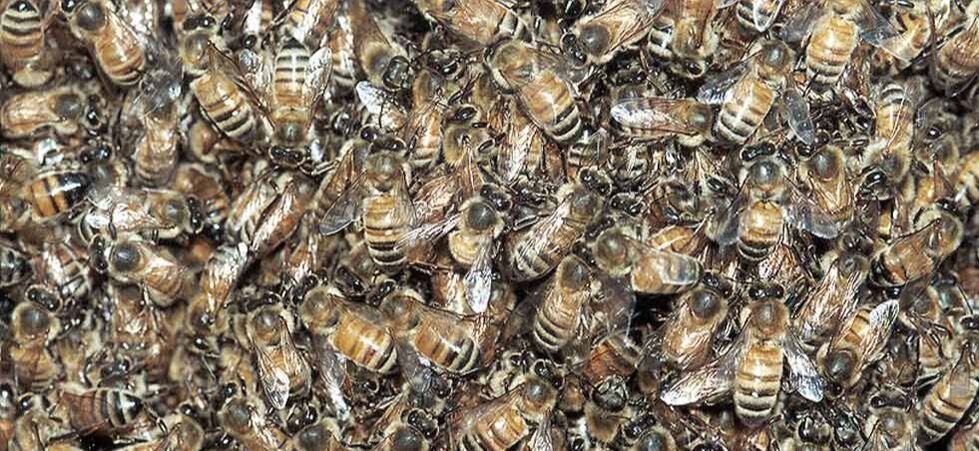
Honeybees have evolved swarming as a method of increasing the number of colonies. In the Spring, usually in May or June, around the middle of the day the queen bee in a colony will emerge outside together with thousands of worker bees, and in a whirling mass, fly off and land nearby on a branch or post or other resting place.

If a swarm is in progress, you will see a lot of bees flying and milling about over about a ten to twenty metre area – the air will appear thick with bees. If you watch carefully from a safe distance you will see the activity is centred around a cluster of bees on a branch (or sometimes a man-made object) usually some way off the ground.

Eventually, in an hour or less, the flying activity will more-or-less cease and the hanging cluster of bees will remain in place. Often this cluster will look like a rugby ball. This is a SWARM – it can be collected by a beekeeper and turned back into a productive honey-bee colony. Eventually, if left to itself, this cluster will fly off to a new home, usually within 24 hours.

They will hang there in a mass somewhat smaller in size than a rugby ball while scout bees go off and explore for possible new homes. The decision process may only take a few minutes, or may fail and the bees remain there, but usually before the end of the afternoon the bees take off again and head for their chosen place. This may be an empty beehive or a hole in a tree or often somebody’s roof.

The so-called ‘killer bees’ (or more correctly, Africanised honeybees) beloved of movie-makers DO NOT OCCUR IN THE UK.

If the presence of a swarm alarms you, remember that swarming bees have other things on their minds than stinging, and so are rarely aggressive. If you just wait they will probably go away anyway.

A swarm (distant view)
A swarm in the branches
of a tree

Closer view
A closer view

Identifying bees and wasps

Honey bees are often confused with wasps and other species of bees.

Before taking any action it is vital to know what insects you are dealing with. Bumblebees and wasps do not swarm, and neither type of colony will last the winter as new queens are produced at the end of the summer, and the old colony dies. The queens find somewhere else to hide away for the winter before starting again elsewhere in the spring.

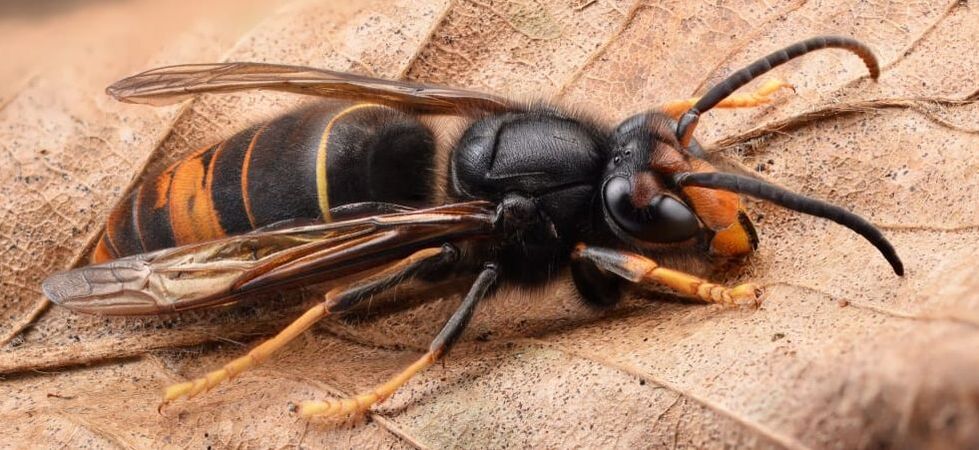
Wasps are often confused with honeybees, as they are more-or-less the same size. Wasps ALWAYS have bright yellow and black stripes and body markings.

Wasp nests can be underground (sometimes) or hanging from an undisturbed branch or in a loft space. The nests are usually roughly spherical, ranging in size from that of a cricket ball to a large beach ball. They are an off-white or pastel brown/grey colour and made of paper chewed from soft wood by the wasps.

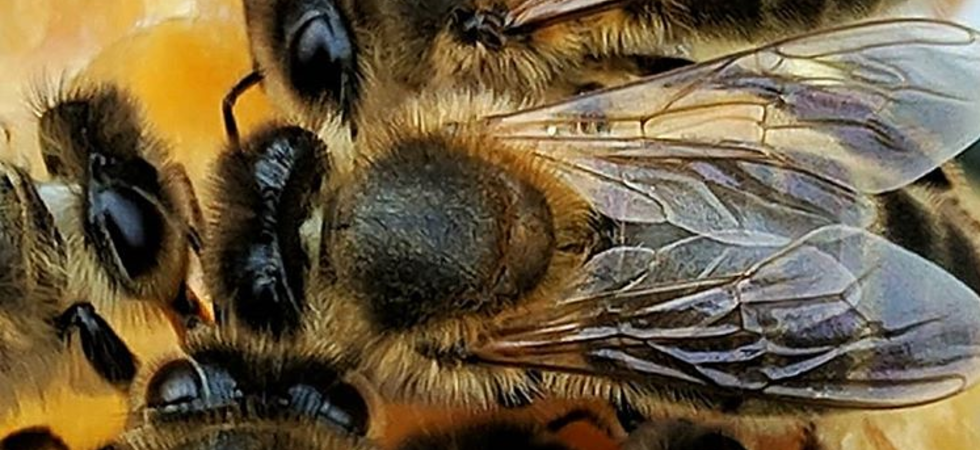
Honeybees vary in colour, from almost black (like a house-fly) to golden brown (like a teddy bear).

If you have insects coming out of a hole in the ground then they are not honeybees. They may be wasps.

If wasps in the ground become a nuisance and you wish to destroy them, any insect powder squirted down the hole after dark will normally finish them off. Interfering with wasp nests is not recommended, and if you need help you should contact your council pest control officer or a specialist firm.

Hornets are like BIG wasps (at least two or three times the size); the colours, markings and nest structure are very similar.

If the insects are round and cuddly then they are probably bumblebees.

These lovely little creatures are becoming rarer and should be preserved as they do a great deal of good as well as being a integral part of nature. Bumblebees are not aggressive and rarely sting, so you have to work hard to upset them.

A worker honey bee
A honey bee

A common wasp
A common wasp

Red tailed bumblebee
A red tailed bumblebee

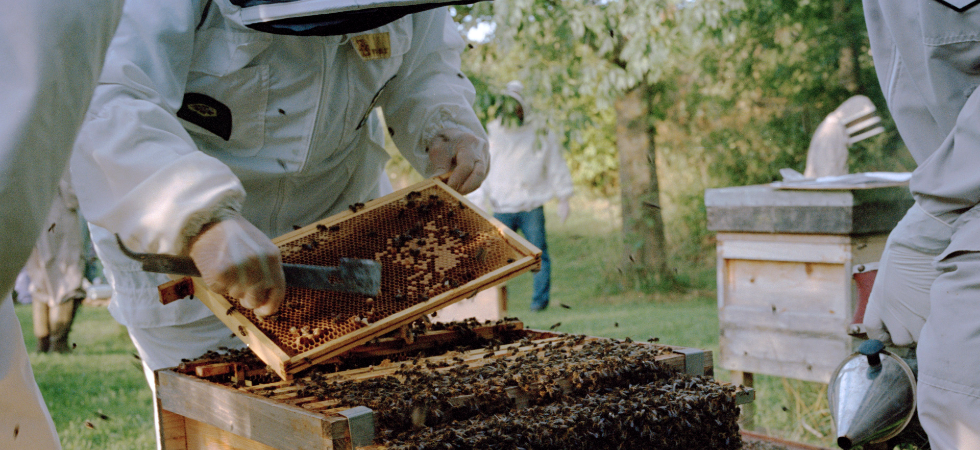
Removing a swarm

While a swarm is hanging in a hedge or tree it is a relatively straightforward job to collect them and re-house them in a hive.

Bear in mind that they may not be there for long, and you would like them gone then you will need to contact somebody quickly.

Insects coming in and out of a roof are more likely to be wasps than honeybees. Unless somebody saw a swarm go in, then the chances are they are wasps. The only sure way is to get up close and have a good look, an option that is not always popular. If they are not causing any trouble then you can just leave them alone. Wasps will die out anyway, and honeybees will probably die out after a couple of years and in the meantime you get the benefit of a free pollination service.

The removal of honey-bee colonies from structures needs to be planned by experts. Do not attempt it yourself because, even if you kill the honeybees, you will leave behind a lot of their honey which will attract other honeybees and wasps, so you will be back to where you started. Any residual pesticide will be picked up and transferred to other colonies of honeybees and kill them too. Most poisonings of honey bee colonies occur for this reason.

Who to contact

While a swarm is hanging in a hedge or tree it is a relatively straightforward job to collect them and re-house them in a hive. Swarms in other places can be more difficult.

To get in touch with one of the beekeepers in the Dean Forest Beekeepers Association, please contact one of our swarm co-ordinators:

Graham Carter, email or phone 01594 861002

Patrick James, email or phone 07786 013869

Jim Lancastle, email or phone 01594 824854

A full list of our member beekeepers who are willing to collect swarms is available here: Swarm Collection 2010

Information for beekeepers

For beekeepers, there is an article on the BBKA web site which explains how to go about collecting a swarm: http://www.britishbee.org.uk/articles/collecting_swarms.php


Acknowledgements

This page uses information from an article written by Chris Deaves, BBKA.